

PLAstic Transport due to waves and currents ON Emerged and submerged beaches (PLATONE)
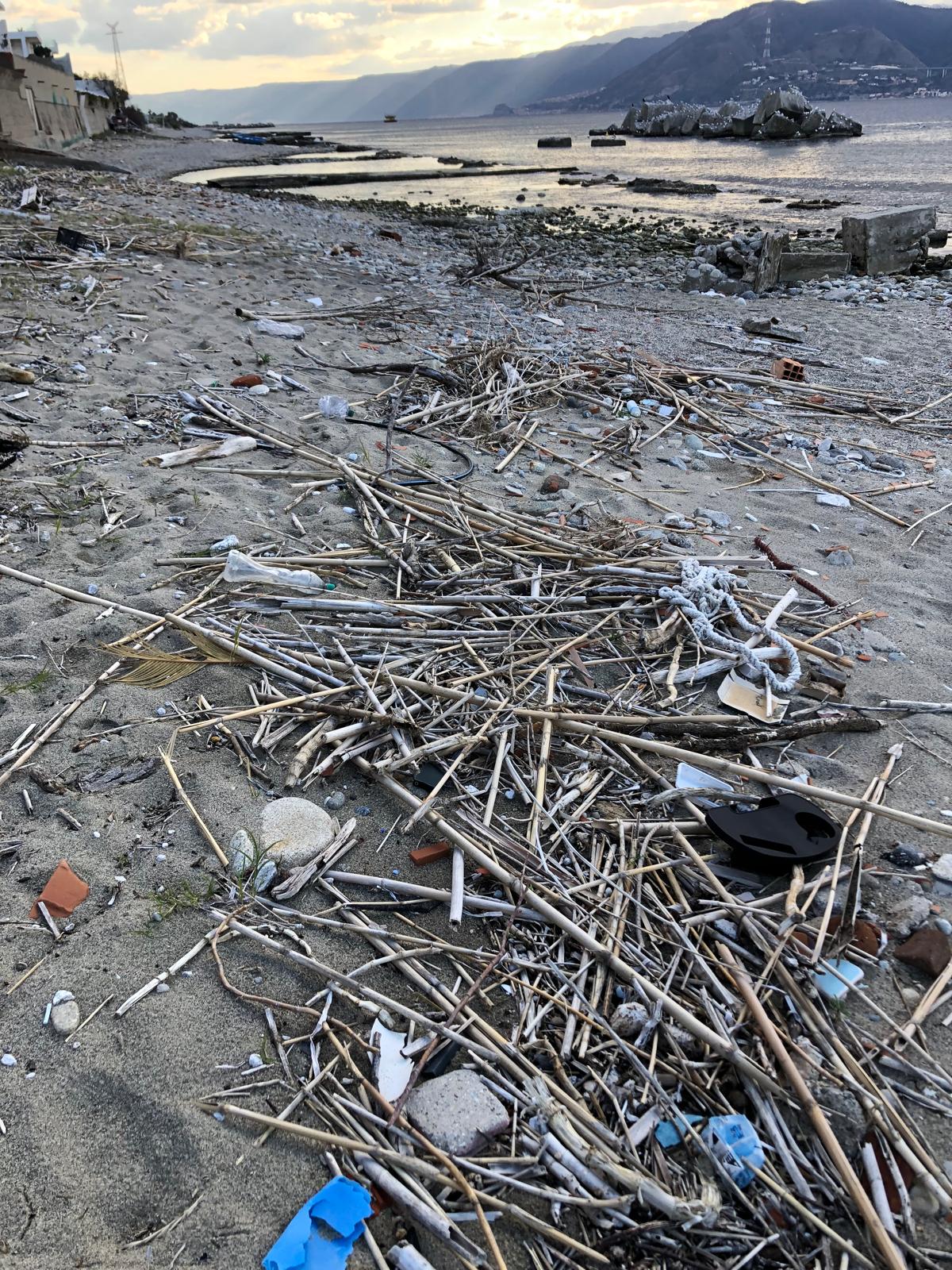
The dramatic and increasing spread of plastics in the marine environment is a major concern due to their persistence in the sea and the negative consequences for marine life and human health. Mitigation strategies require an understanding and quantification of the sources, pathways, and fate of marine plastics.
Although the distribution of plastics in the open sea has been extensively studied, the dynamics in the surf and swash zones are still at an early stage of investigation, and little is known about how plastic particles are transported by waves toward the shore and how they are distributed on emerged and submerged beaches. Further studies are needed to improve knowledge on the vertical distribution of plastics in the water column, degradation processes, and the mechanisms of beaching and washing-off under the action of regular and irregular waves combined with currents.
Within the framework of the PLATONE project, the physical processes that lead anthropogenic debris to accumulate on emerged beaches and disperse on submerged beaches have been investigated. Physical and numerical modeling, conducted under a variety of wave and current conditions, has been combined and integrated to study the processes that can determine beaching and the retrieval of waste material on emerged beaches. At the same time, research has focused on the seabed, where the interaction processes between the flow field and sand–plastic mixtures are almost unknown.
Research Units Involved
University of Messina (UniME)
Carla FARACI (Principal Investigator)
Carla Faraci is a Full Professor at the University of Messina. She is the Scientific Director of the Hydraulics Laboratory. She is a member of the Technical-Scientific Committee of the Basin Authority of the Sicily Hydrographic District – Presidency of the Sicily Region, a member of the PhD Board in Engineering, and an external expert on the Technical-Administrative Committee of the Interregional Public Works Authority for Sicily – Calabria.
She has served as scientific coordinator of the European projects EU TA HY+ WINGS (2018) and INTERREG Italy–Malta 2020–27 MAESTRI, and of the national projects PRIN2022 PLATONE (2024–2026), and BAC RAISE Passport (2025), as well as numerous agreements with public and private institutions.
Her research interests, documented in over 60 publications indexed in major databases, focus primarily on marine hydraulics and coastal engineering, wave–current interactions, wave-induced effects on coastal structures, wave energy extraction, the use of neural networks for wave forecasting, the transport of plastics in coastal environments, and the marine propagation of oil spills.
Claudio IUPPA

Claudio Iuppa was born in Enna on August 7, 1985. On July 19, 2011, he earned a degree in Environmental and Land Engineering from the University of Catania, graduating with full marks and honors (110/110 cum laude). In January 2016, he obtained a PhD in Hydraulic, Sanitary-Environmental, and Transport Infrastructure Engineering (28th Cycle) from the University of Catania, defending a thesis entitled “Optimization of Cast Marine Dams for Wave Energy Extraction.” Since March 2023, he has been a Fixed-term Researcher in the Scientific-Disciplinary Sector ICAR/01 at the Department of Engineering, University of Messina. He teaches in various courses and has served as principal investigator on research projects and in consultancy roles.
His research activity is primarily focused on coastal hydrodynamics, wave energy devices, wave motion forecasting, and the dispersion of pollutants at sea. These research activities are carried out through laboratory experiments, numerical modeling, and the application of neural networks.
GIULIA BONANNO
Giulia Bonanno was born on May 6, 2000. In 2023, she earned a Master’s Degree in Civil Engineering (LM-23) from the University of Messina, graduating with full marks and honors (110/110 cum laude). From January 2024, she carried out one year of research within the PLATONE project, focusing primarily on laboratory experimental activities. Since December 2024, she has been a PhD student in Engineering at the University of Messina.
Her current research is focused on predicting pollutant dispersion using neural networks, with particular emphasis on Physics-Informed Neural Networks (PINNs), aiming to integrate her engineering expertise with advanced computational tools.
IMEN CHEBBI

Imen Chebbi earned a degree in Science and Technology, specializing in Ecosystem Dynamics, from the University of Sfax (Tunisia) in 2017–2019. She then completed a one-year second-level Master’s program at the University of Le Mans (France), focusing on the processing of oceanographic data and integrated analysis of coastal ecosystems and their resilience.
During her academic training, she developed skills in project support and contributed to capacity-building activities aimed at promoting community-based solutions for long-term ecological and socio-economic resilience. Since 2025, she has been a Research Fellow within the PLATONE project, actively participating in laboratory experiments studying wave-induced plastic waste transport. In parallel, she is involved in the MAESTRI project, contributing to the development of remote sensing–based solutions for mitigating the impact of plastic pollution in coastal areas.
University of Catania (UniCT)
Enrico FOTI

Enrico Foti is currently a Full Professor in the CEAR-01/A – Hydraulics scientific sector at the University of Catania. He is an expert in the hydrodynamics and morphodynamics of coastal and riverine environments. His research covers a wide range of topics, including the analysis and mitigation of hydraulic risk in both marine and riverine contexts, wave energy production, and the study of transport induced by wave–current interactions through both physical and numerical modeling.
He has extensive experience in coordinating national and international research projects. In addition, he carries out intensive professional activities, mainly for public institutions, with both national and international clients, focusing on coastal and marine hydraulics, port engineering, river hydraulics, and hydraulic risk mitigation.
Rosaria Ester MUSUMECI
Rosaria Ester Musumeci is currently a Full Professor in the CEAR-01/A – Hydraulics scientific sector at the University of Catania. She is an expert in the hydrodynamics and morphodynamics of coastal and riverine environments. Her research has focused primarily on the experimental and numerical investigation of the interactions between marine waves, currents, mobile seabeds, and coastal structures.
Recently, her work has concentrated on assessing the vulnerability of strategic assets (e.g., ports, dam systems, cultural heritage, natural capital) to extreme events induced by meteorological conditions. These activities have been carried out within numerous national and international research projects, in several of which she has served as Principal Investigator or local coordinator.
Luca CAVALLARO

Luca Cavallaro is currently an Associate Professor in the CEAR-01/A – Hydraulics scientific sector at the University of Catania. His research focuses on the hydraulics of natural systems, the interaction between water bodies and infrastructure, and the development of hydraulic early warning systems.
He has served as the scientific coordinator of research projects related to the implementation of hydraulic and coastal early warning systems based on the use of artificial neural networks. He has also provided consultancy for leading national engineering and construction companies.
Martina STAGNITTI

Martina Stagnitti is currently a Fixed-term Type A Researcher in the CEAR-01/A – Hydraulics scientific sector at the University of Catania. Her research, conducted within national and international projects as well as scientific collaboration agreements, focuses on: i) physical and numerical modeling of wave–coastal structure interactions; ii) assessment of the impacts of climate change on coastal systems; iii) numerical study of sediment transport induced by littoral currents; iv) investigation of river flood propagation processes to identify solutions for flood risk mitigation.
Giovanni PASSALACQUA
Giovanni Passalacqua holds a Master’s degree in Civil Engineering from the University of Messina. After a period of professional activity with engineering firms and design studios, from 2021 to 2024 he completed a PhD at the same University, conducting experimental research on the dynamics of non-floating plastic debris in coastal environments. During his PhD, he also carried out a research period at the laboratories of the Technical University of Denmark (DTU).
Since 2024, he has been a Research Fellow at the University of Messina (Minosse project) and subsequently at the University of Catania (Platone project), where he conducts tests and analyses on the dynamics of floating plastic particles, with particular focus on transport velocity and beaching mechanisms along the shoreline profile.
Fabrizio NARZISI

Fabrizio Narzisi is currently a PhD candidate in the National PhD Program in Defense against Natural Hazards and Ecological Transition of the Built Environment – 40th cycle (XL) at the University of Catania. He earned his Master’s degree in Civil Engineering of Water and Transport Systems (Water Curriculum) at the same university, defending a thesis entitled “Impact of Wave Forcing Variability on the Structural Design of Breakwater Walls: The Case of the Catania Port Breakwater.”
His research activity focuses on the experimental investigation of plastic transport conditions over seabeds characterized by the presence of ripples.
National Institute of Geophysics and Volcanology (INGV)
Giuseppe BILOTTA

Giuseppe Bilotta holds a degree in Mathematics from the University of Catania. Since 2008, he has collaborated with the Etna Observatory, Catania Section of the National Institute of Geophysics and Volcanology (INGV), where he has been a researcher since 2017. His work focuses on the modeling of geophysical flows and the development of numerical models for computational fluid dynamics on high-performance computing (HPC) platforms.
He is also a contract lecturer for the course “Parallel Programming on GPU Architectures” in the Computer Science degree program at the University of Catania.
Roberta CRISTOFARO

Roberta Cristofaro holds a degree in Environmental and Land Engineering from the University of Bologna. Since 2021, she has been working in research, initially at ENEA, participating in projects on smart cities, service digitalization, and environmental sustainability, with a focus on data analysis.
Since 2024, she has been a researcher at the National Institute of Geophysics and Volcanology (INGV) within the PLATONE project, where she works on the validation of a numerical model for plastic transport in coastal environments based on the Smoothed Particle Hydrodynamics (SPH) method, implemented using GPUSPH. She is currently a PhD student at the University of Catania in the program “Assessment and Mitigation of Urban and Territorial Risks.”
Objectives
The main objective of the project is to identify the transport mechanisms of floating and non-floating plastics in marine and coastal environments. In particular:
O1) Classify waste materials that may be found on emerged or submerged beaches according to their origin and physical and biochemical properties, using both existing data and new data acquired through targeted field surveys (distinguishing between floating/non-floating; anthropogenic/non-anthropogenic; biodegradable/non-biodegradable).
O2) Develop models of the processes that can lead to the dispersion of waste materials on the emerged beach or along the submerged beach, with particular attention to beaching (stranding) phenomena and washing-off back to the sea.
O3) Identify the preferential pathways, both on the emerged beach and in the coastal marine area (swash zone and surf zone), where waste materials tend to accumulate.
O4) Propose mitigation solutions and strategies to reduce the trapping of waste materials.
O5) Disseminate the project results to raise public awareness and foster a network with other projects funded on related topics.
Conducted Research
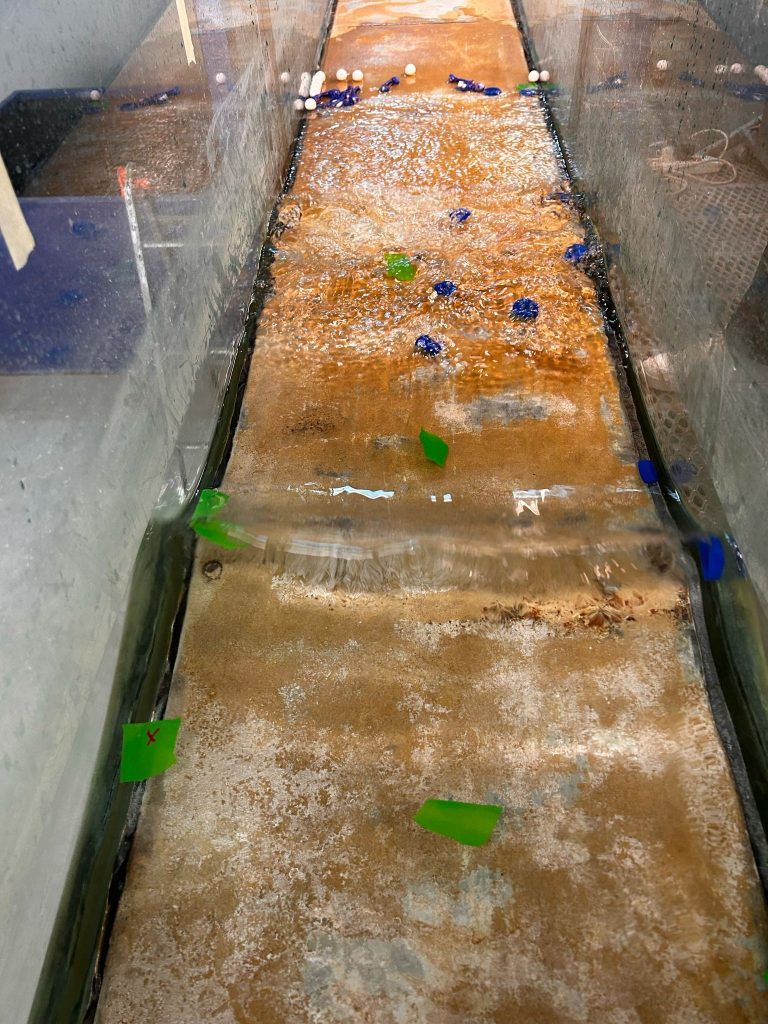
The activity was conducted experimentally within a wave flume, investigating the physical processes driving the movement by identifying the conditions for incipient motion, determining the transport over beds with varying roughness (both horizontal and inclined), and measuring settling or rising velocities in the presence or absence of waves.
In parallel, numerical simulations were carried out using two different approaches: a Lagrangian approach, aimed at identifying plastic hotspots within a domain selected as a case study (the Bay of Milazzo), and a GPU-SPH technique, an open-source CFD software capable of identifying plastic particles and modeling their transport in marine–coastal environments, through which an attempt was made to reproduce the experimental results.
Results
The main results achieved within the project can be summarized as follows:
R1) Database of the main types of waste identified at the Milazzo Coast site;
R2) Experimental results (identification of incipient motion conditions; determination of transport conditions; settling velocity; rising velocity; beaching velocity) and numerical results (large-scale Eulerian–Lagrangian simulations to estimate plastic hotspots; and small-scale GPUSPH simulations to reproduce specific aspects of the experimental activities);
R3) Maps of potential debris accumulation areas at the experimental site and in the selected sample areas;
R4) Identification of best practice cases;
R5) Engagement and awareness-raising of active citizens.
Deliverables
D1.1: Progress report containing a review of the state of the art, the research gaps, and the open questions
D1.2: Debris database implemented on a GIS-based platform
D2.1: Progress report containing a database of the investigated experimental conditions
D2.2: Progress report containing a database of the investigated numerical conditions, for both wave-averaged and SPH models, including the full setup information and, where possible, test cases files for reproducibility of the results
D2.3: Journal and conference publications. At least two journal papers and four conference proceedings are expected to be published within 18 months after the closure of the project
D3.1: Report on the main current available mitigation solutions to be set in terms of beach and coastal sea cleaning procedures and possibility to be applied to the case study.
D3.2: Pathways implementation on the GIS-based platform (in connection with D1.2)
D4.1: Report of practices set up in different parts of the world, selection of the most appropriate for the selected case study
D4.2: project exhibition: photos & collected samples
D5.1: Project website, social media impact, mass media releases
D5.2: Final event
D5.3: technical reports, educational papers; scientific publications.
Publications
- Passalacqua, G., Bonanno G., Iuppa, C., Faraci, C., (2026), Wave-induced transport of non-buoyant microplastic particles: Phase-resolved experiments and excess-Shields scaling, Coastal Engineering, Volume 206, 104968, https://doi.org/10.1016/j.coastaleng.2026.104968.
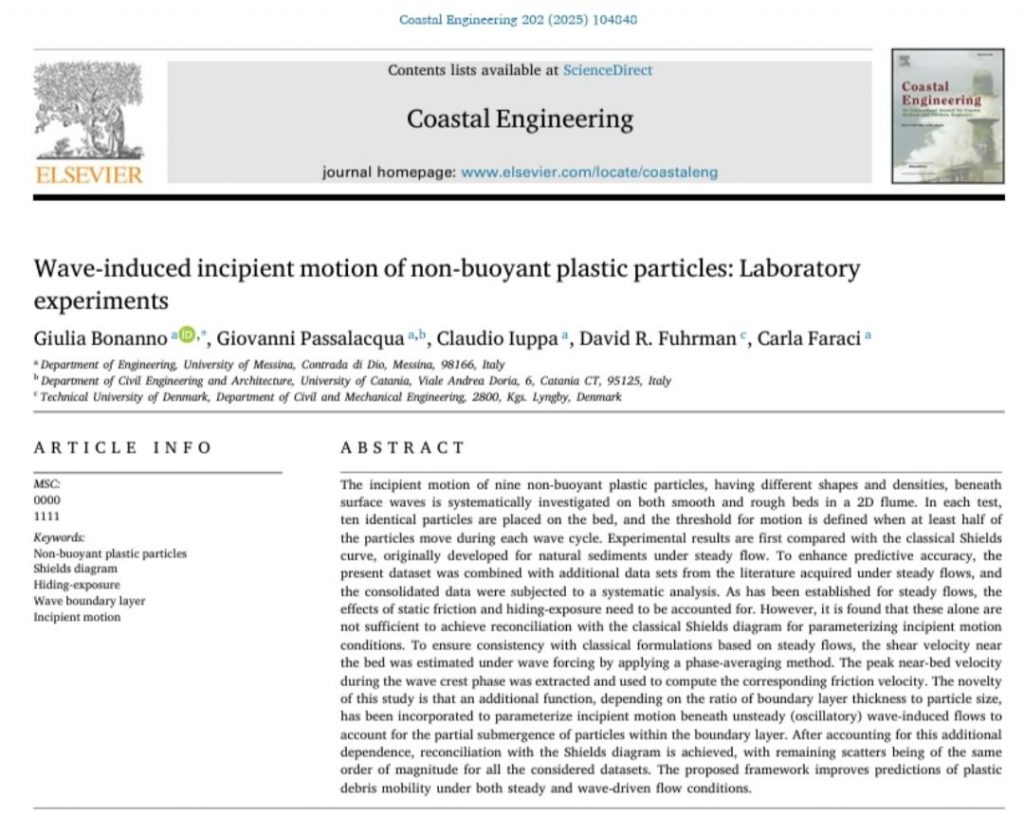
- Bonanno, G., Passalacqua, G., Iuppa, C., Fuhrman, D.R., Faraci, C., (2025) Wave-induced incipient motion of non-buoyant plastic particles: Laboratory experiments, Coastal Engineering, Volume 202,104848, https://doi.org/10.1016/j.coastaleng.2025.104848.
- Cristofaro R. , Cappello A., Ganci G. , Iuppa C. , Faraci C. , Bilotta G. (2025) Development and validation of an SPH model for simulating plastic transport in nearshore zone: A Laboratory – Scale Case Study – GNGTS2025
- Cristofaro R. , Cappello A., Ganci G. , Iuppa C. , Faraci C. , Bilotta G. (2025) Validation of an SPH model for plastic transport – ICNAAM 2025
- Cristofaro R. , Cappello A., Ganci G. , Bilotta G. Iuppa C. , Faraci C. (2025) SPH MODELING FOR PLASTIC TRANSPORT IN THE NEARSHORE ZONE: A LABORATORY-SCALE VALIDATION STUDY – SPHERIC 2025
- Passalacqua, G.,Chebbi I.,Iuppa, C., Narzisi, F., Cavallaro, L.,Musumeci, R.E., Foti, E., Faraci, F., (2025) Experimental Study on Nearshore Transport of Buoyant Plastic Particles Under Irregular Waves, IEEE International Workshop on Metrology for the Sea (METROSEA). pp. 538-543, doi: 10.1109/MetroSea66681.2025.11245684
- Iuppa, C., Passalacqua, G.,Chebbi I., C. Faraci, F., (2025). A numerical tool for buoyant plastic debris transport prediction in the nearshore zone,. IEEE International Workshop on Metrology for the Sea (METROSEA); pp. 312-316, doi: 10.1109/MetroSea66681.2025.11245755.
- Stagnitti M. , Musumeci R. (2024) Model-based estimation of seasonal transport of macro-plastics in a marine protected area. Mar. Pollut. Bull., 201, 116191
- Iuppa, C., Passalacqua, G., Faraci, F., (2024). An equilibrium criterion for plastic debris fate in wave-driven transport, Marine Pollution Bulletin, Volume 206, 116758, https://doi.org/10.1016/j.marpolbul.2024.116758.
- Passalacqua, G., Bonanno, G., Salmeri, F., Iuppa, C., Cucinotta, F., Faraci, C., (2024). Density effect in cubic microplastics on settling velocity and incipient motion due to oscillatory forcing. Euro-Mediterranean conference for environmental integration (EMCEI)
- Bonanno, G., Passalacqua, G., Iuppa, C., & Faraci, C. (2024). Detection of incipient motion for non-buoyant plastics under wave motion. 5th IAHR Young Professionals Congress
- Bonanno, G., Passalacqua, G., Iuppa, C., & Faraci, C. (2024). Moto incipiente di micro e macro plastiche sotto l’azione di onde di mare: risultati preliminari di una campagna sperimentale. Convegno Nazionale di Idraulica e Costruzioni Idrauliche (IDRA)
- Passalacqua, G., Tan,R.I.,Carstensen, S., Iuppa, C., Faraci, C.,Larsen, B.E., Kerpen, N.B., Schlurmann,T., Fuhrman, D.R. (2024), Experimental study of microplastic particle transport in the presence of gravel and marine vegetation under irregular wave and current conditions., Convegno Nazionale di Idraulica e Costruzioni Idrauliche (IDRA)
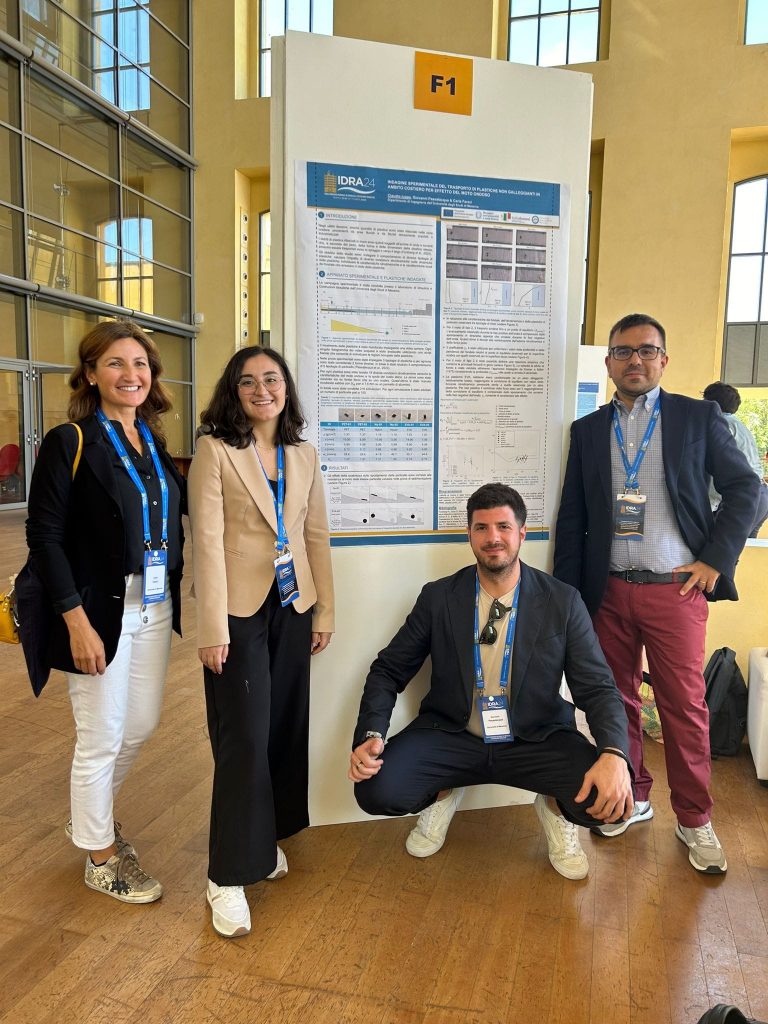
- Iuppa C., Passalacqua G., Faraci C., (2024) Indagine sperimentale del trasporto di plastiche non galleggianti in ambito costiero per effetto del moto ondoso. Convegno Nazionale di Idraulica e Costruzioni Idrauliche (IDRA)
Faraci C., Bonanno G., Passalacqua G., Cucinotta F., Iuppa C. (2024) The transport of plastics debris in coastal seas: results of physical modeling. Convegno Nazionale di Idraulica e Costruzioni Idrauliche (IDRA)
- Passalacqua, G., Iuppa, C., & Faraci, C. (2023). A Simplified Experimental Method to Estimate the Transport of Non-Buoyant Plastic Particles Due to Waves by 2D Image Processing. Journal of Marine Science and Engineering, 11(8), 1599. https://doi.org/10.3390/jmse11081599
- Iuppa, C., Passalacqua, G., Fuhrman, D. R., & Faraci, C. (2023). A non-invasive laboratory technique for wave-driven plastic debris motion detection. IEEE International Workshop on Metrology for the Sea (METROSEA), Vol. 245, pp. 410–414. https://doi.org/10.1109/metrosea58055.2023.10317313.