
RESEARCH
Research Focus
Our research focuses on:
The research activities of the Coastal Engineering at the University of Messina focus on the study of hydrodynamic and morphodynamic processes in marine environments, with particular emphasis on the interactions among waves, currents, sediments, and pollutants.
The research combines experimental, numerical, and field-based approaches, with applications aimed at the sustainable management of coastal zones and the mitigation of anthropogenic impacts.
MAIN RESEARCH TOPICS
Plastic pollutants
We investigate the transport and beaching of plastic debris in coastal environments by relating wave and current dynamics to the physical properties of the objects (density, shape, and buoyancy). Our contribution lies in quantifying the mechanisms of mobilization and accumulation and in providing indicators useful for predicting areas at risk. The activity integrates laboratory experimental campaigns, numerical modeling, and field investigations, including video analysis techniques and monitoring instruments.
Oil spill
We investigate the dynamics and dispersion of hydrocarbons in the marine environment, focusing on surface transport processes, diffusion, and interactions with wave motion and coastal features. Our contribution lies in developing predictive tools to support operational response by estimating spill trajectories, arrival times, and impact scenarios. This approach combines hydrodynamic and transport numerical modeling with data-driven techniques and neural networks to enhance both the speed and accuracy of predictions.
Sediment transport
We study the processes of sediment erosion, transport, and deposition that govern the morphological evolution of beaches and seabeds, including the effects of extreme events. Our contribution focuses on interpreting and parameterizing the physical mechanisms controlling profile changes and sediment budgets, providing insights for coastal defense and management strategies. The research integrates laboratory experiments, numerical simulations, and field observations/monitoring.
Wave motion forecasting
We develop wave forecasting models for engineering and management applications, ranging from maritime infrastructure planning to coastal risk assessment. Our contribution is the construction of reliable and easily updatable forecast chains, with products calibrated for specific areas of interest. The approach integrates numerical models of wave generation and propagation, calibration and validation using measurements and buoy data, and statistical and machine learning models.
OUR LABORATORY
Department of Engineering (UniMe), Block A – Ground Floor – Rooms 3 and 4.
The Hydraulic and Hydraulic Structures Laboratory (LICI) is the experimental facility supporting the group’s activities in coastal and river hydro-morphodynamics, encompassing research, teaching, and community services.
The main activities conducted through physical model experiments focus on the interaction between waves and port or coastal defense structures, the assessment of hydraulic and shoreline erosion risk, beach nourishment and management of underwater quarries, pollutant dispersion, and plastic transport, among others. Research carried out in the laboratory results in scientific outputs such as publications in national and international conference proceedings, peer-reviewed journals, and internal reports. Laboratory studies also support numerous experimental theses, including both undergraduate and doctoral dissertations. Finally, the laboratory’s consultancy and territorial service activities translate research findings into technical reports that inform and support design projects in collaboration with research stakeholders.
Experimental setups
- A flume with an adjustable bottom slope of up to 1:100, rectangular cross-section (0.4 × 0.8 m), and 15 m in length, equipped with a wave generator. The facility has been recently upgraded to conduct hydrodynamic and morphodynamic investigations under both regular and irregular wave conditions, capable of reproducing wave heights up to approximately 10 cm and oscillation periods up to about 2 s.
- A U-shaped flume for simulating oscillatory flows at high Reynolds numbers, with a rectangular cross-section of 0.4 × 0.6 m and a useful length of 5 m. The facility is equipped with a recirculation system capable of flows up to 250 L/s and can reproduce oscillatory motions with amplitudes up to 1 m and periods ranging from 4 to 10 s. The facility is currently undergoing maintenance and upgrades and is therefore not available for use at this time.
- Demonstration training channel for exercises and tests on free-surface motion.
Measurement and acquisition instruments
Acoustic velocity meter “Vectrino Profiler” (Nortek – AS), designed to record velocity profiles at an acquisition frequency of up to 100 Hz over a height of 3 cm, with a spatial resolution of 1 mm.
- Pressure probes for the measurement of pressures and the determination of hydrodynamic parameters during experimental tests.
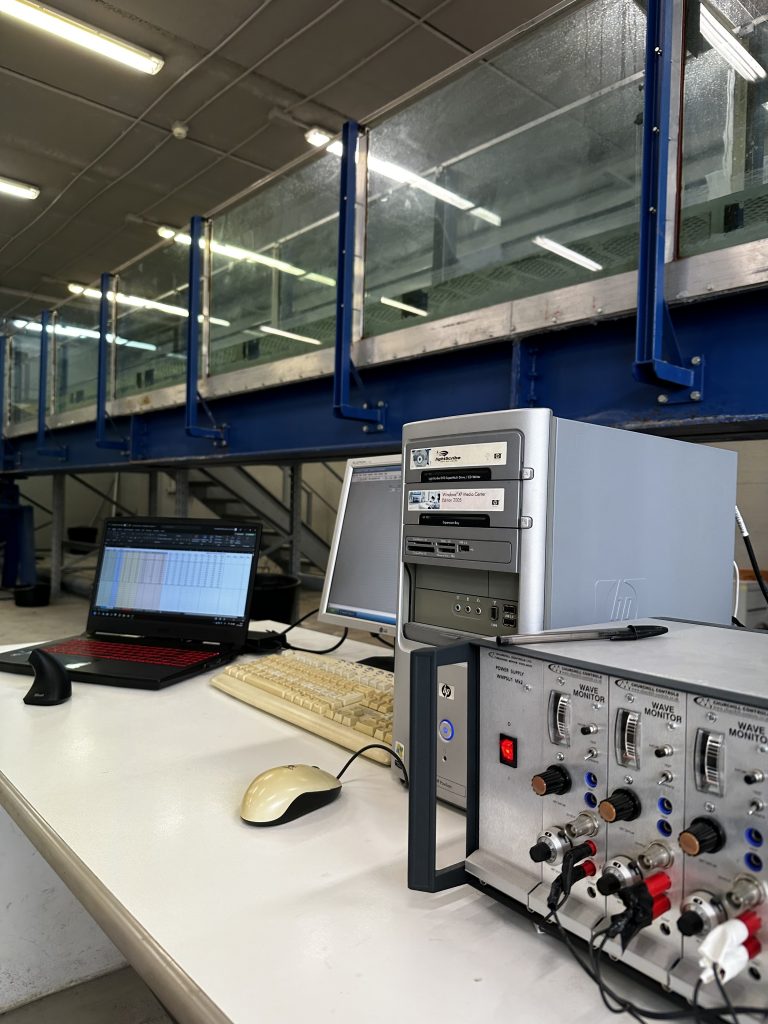
The Wavemonitor Module (Churchill Controls Ltd) is a system for monitoring waves and surface water levels, featuring five acquisition channels, each capable of recording potential differences up to ±10 V at a sampling rate of 50 Hz.
- Image acquisition systems for video analysis and tracking of phenomena (kinematics and transport processes).