

Touching the transcendentals
by tractional constructions
historical and foundational research, educational and museal applications by new emerging technologies
PROJECT OVERVIEW
DESCRIPTION
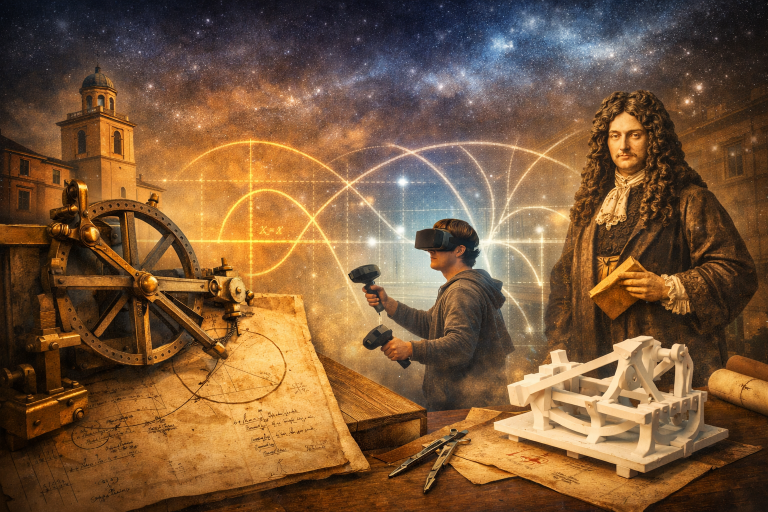
This project reimagines calculus through its geometric roots, studying tractional motion and combining historical research, mathematics, education, and emerging technologies like VR and digital fabrication.
Our research group brings together historians of mathematics, mathematics educators, and experts in scientific instruments and digital technologies. We aim to rediscover forgotten mathematical machines, design new physical and virtual models, and create innovative learning and museum experiences.
RESEARCH
Abstract
Calculus revolutionized scientific thought but remains conceptually demanding, especially because it involves infinitary processes. This project reinterprets calculus through its geometric and constructive origins, focusing on tractional motion—an early mechanical method, developed around Leibniz, for generating transcendental curves. Our research combines history of mathematics, theoretical analysis, educational experimentation, and emerging technologies such as Virtual Reality and digital fabrication.
Fundings
This is a PRIN 2022 research project funded by the Italian Ministry of University and Research and the European Union (NextGenerationEU). It develops a multidisciplinary investigation on tractional motion, a geometric method used to construct transcendental curves and to provide early mechanical justifications of calculus.

OUR TASKS
Main objectives
Historical and mathematical analysis.
We investigate the development of tractional motion, with special attention to Giovanni Poleni, and explore its underused mathematical potential, including new constructive approaches to differential equations.
Educational experimentation with physical and virtual machines.
We design laboratory activities using both handcrafted tractional devices and VR environments, developing methodologies to evaluate their impact on learning.
Technological dissemination.
We employ digital fabrication and Virtual Reality to make tractional motion accessible beyond traditional artifacts, producing VR applications and open-source designs for mathematical machines.
Historical and mathematical analysis. We investigate the development of tractional motion, with special attention to Giovanni Poleni, and explore its underused mathematical potential, including new constructive approaches to differential equations.
Educational experimentation with physical and virtual machines. We design laboratory activities using both handcrafted tractional devices and VR environments, developing methodologies to evaluate their impact on learning.
Technological dissemination. We employ digital fabrication and Virtual Reality to make tractional motion accessible beyond traditional artifacts, producing VR applications and open-source designs for mathematical machines.
Task 1
Historical and foundational studies on tractional motion, with special attention to Giovanni Poleni and his instruments.
Task 2
Mathematical analysis of the undisclosed potential of tractional machines, including complex differential equations.
Task 3
Design and development of Virtual Reality environments reproducing historical and modern mathematical machines.
Task 4
Educational experiments with VR machines.
Task 5
Educational experiments with physical tractional machines.
Task 6
Digital fabrication for the dissemination of mathematical machines in schools and museums